
HPV Vaccine After 25: What Every Adult Should Know Part 1

Smiling young woman with curly hair standing confidently, symbolizing empowerment through HPV vaccination awareness.

A confident woman stands as a reminder that HPV vaccination empowers adults to protect their health at any age.

Funke was scrolling through posts on Facebook when she encountered content from a popular healthcare influencer on the human papillomavirus (HPV) vaccine and how it helps girls aged 9 to 14 prevent genital warts and cervical cancer.
“What about me?” she wondered. “I’m over 25 — can’t it help me avoid the pain and suffering from HPV-related diseases?”

Like Funke, you might be asking a similar question: Can adults over 25 get the HPV vaccine? This piece provides the burning answers you’ve been looking for.

What Are the Chances of Getting HPV After 25?

The risk of getting HPV after age 25 remains significant. The infection is most common during youth, especially because of social behaviours and risky lifestyles. In fact, within four years of becoming sexually active, about 63% of women become infected.

But the risk doesn’t end there — people over 25 can still catch HPV and remain at risk for the rest of their lives. Once infected, the virus might disappear or stay hidden in the body, only to come back later.

Unlike viruses such as chickenpox, getting HPV once doesn’t protect you from future infections. You can get infected again with the same or different HPV types, even if your body cleared the first infection.

Your chance of HPV infection after 25 increases with new sexual partners. This shows that natural protection doesn’t do much to defend against the virus throughout a woman’s life. In fact, many studies have shown a second rise in HPV cases after age 45 or 50, often around the time of menopause.

Why HPV Vaccination Matters for Adults

Over the past 30 years, people have been getting married later and more have experienced divorce. Because of this, it has become more common for people to have new romantic or sexual partners both before marriage and again in middle age, which adds to the ongoing risk of HPV.

If both young adults and older women still face this risk, why aren’t more adults being vaccinated? Some healthcare providers believe that older women must have already been infected, so the HPV vaccine for adults wouldn’t be useful. But is there a way to check if someone had HPV before getting vaccinated?

Currently, no commercial tests are available to confirm past HPV infections before vaccination. The tests that would be needed aren’t widely accessible, and even if they were, they would likely be expensive and difficult to use in many parts of the world — especially in regions like Nigeria and other low- and middle-income countries.

That’s why HPV vaccination for women over 25 remains one of the most practical and powerful ways to protect against cervical cancer, genital warts, and other HPV-related diseases.

In part two, we discussed what happened when the vaccine was administered to people over 25 years, and the result will amaze you. To learn more about HPV and how it can be prevented, you can follow us on Instagram or sign up for our newsletter.
Get Your Yellow Fever Vaccination in Nigeria Early

Get Your Yellow Fever Vaccination in Nigeria Early

Yellow fever vaccination Nigeria

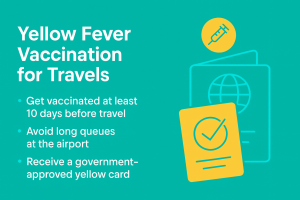
A turquoise-green Inocul8 infographic showing a yellow card and passport.

Tunde was thrilled to attend a conference in Ethiopia. At the airport, he learned that he needed a yellow fever certificate and that he must receive the yellow fever vaccine at least 10 days before travel. That simple rule changed everything.

The Risk of a Last‑Minute Rush

Tunde left Ajah at 4:30 a.m. for the Murtala Muhammed International Airport. It was a risky, costly, and stressful endeavour. Only 150 people were accepted that day, so he had to return.

Act early. Book your yellow fever vaccination in Nigeria well in advance to avoid delays and long queues.

Short on time? Inocul8’s yellow fever vaccination service in Lagos helps you get vaccinated and receive your government‑approved yellow card quickly.

Long Queues and Delays

  • Online payments and passport biodata copies
  • Moving between buildings
  • Hours of waiting—sometimes over five hours

Inocul8 Yellow Fever Vaccination Service offers a fast, hassle‑free process for busy travellers. No endless lines. No wasted hours.

Why the 10‑Day Rule Matters

You must take the yellow fever vaccine at least 10 days before you fly. Your body needs time to build protective antibodies. Many people gain protection by day 10; some take up to 30 days. Get vaccinated early and travel with confidence.

Scarcity and Fake Yellow Cards

Sometimes, yellow card certificates run out at government centres. Some travellers are tempted by fake cards. This can cause denial of entry abroad.

Use only government-approved vaccination clinics in Nigeria, such as Inocul8, to obtain an authentic, yellow fever vaccination record that meets travel health requirements in Nigeria.

Why Choose Inocul8?

  • Authentic yellow card certificate in Nigeria
  • Quick yellow fever vaccine appointments with minimal waiting
  • Safe, clean, and professional service

Save time, stress, and energy. Focus on your trip, not the queue.

Key Takeaways

  • Book your yellow fever vaccination in Nigeria at least 10 days before travel.
  • Avoid long queues with Inocul8’s travel vaccination service in Lagos.
  • Protect yourself from fake yellow card certificates.
  • Use approved yellow fever vaccination centres in Nigeria for a valid card.

Ready to Travel?

Skip the stress. Get your yellow fever vaccine in Nigeria and a yellow card certificate through Inocul8.

Book Your Appointment. You can read our last post on why yellow fever vaccination is a mandatory travel requirement for Nigerians.

Why Yellow Fever Vaccination is a Mandatory Travel Requirement for Nigerians

✈️ A Story Many Travellers Can Relate To

Dayo, a 34-year-old Nigerian, was preparing for his long-awaited trip to Brazil when his travel agent called with bad news: his documents were incomplete because his yellow card certificate was missing.

He was shocked and frustrated. “I’ve submitted every document! Why is this yellow card such a big deal?” he asked.

That simple question opens up an important conversation: Why is yellow fever vaccination mandatory for Nigerians travelling to certain countries?

What is Yellow Fever?

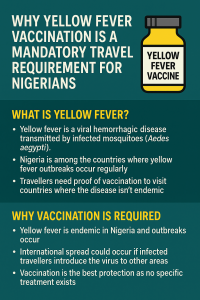
Yellow fever is a viral hemorrhagic disease (similar to Ebola) transmitted by infected Aedes aegypti mosquitoes.
Nigeria is one of several countries where yellow fever outbreaks occur regularly, and the disease remains a major public health concern.

Travellers from Nigeria who plan to visit countries where yellow fever is not endemic must show proof of vaccination through a yellow card certificate.

Yet, many Nigerians still don’t realise that this small yellow booklet is a crucial travel document, as essential as a passport or visa.

Why Yellow Fever Vaccination is Required for Nigerians

Yellow fever is endemic in Nigeria, meaning the virus circulates continuously in the environment. Occasional outbreaks lead to nationwide vaccination campaigns to control transmission.

When an unvaccinated traveller from Nigeria visits a country where yellow fever isn’t common, there’s a risk of importing the virus into that country.
This could expose people who have no immunity and cause new outbreaks in previously unaffected areas.

There’s also no specific treatment for yellow fever, only supportive care.
This makes prevention through vaccination the best and only effective protection.

The Legal Side: International Health Regulations (IHR 2005)

Some travellers joke, “I don’t need the shot, just give me the certificate.”
But here’s the truth: this isn’t optional, it’s international law.

Under the World Health Organisation’s International Health Regulations (IHR 2005), yellow fever is the only disease that legally requires proof of vaccination for international travel.

Countries have the authority to:

  • Deny entry to unvaccinated travellers from risk zones (like Nigeria).

  • Request valid yellow cards at airports and border posts.

  • Quarantine travellers who fail to comply.

Your yellow card certificate is officially known as the International Certificate of Vaccination or Prophylaxis (ICVP). Immigration officers will check it upon arrival and verify its authenticity.
Trying to bypass the system with fake documents isn’t just risky — it’s a violation of international law.

Why It’s Especially Important for Nigerians

Nigeria has recorded recurrent yellow fever outbreaks in states such as Bauchi, Delta, Benue, and Edo. Because of this, the country is classified by the WHO as high-risk for yellow fever transmission.

As a result, many countries, especially in South America, Asia, and the Middle East, require Nigerian travellers to show proof of vaccination before entry or even during layovers.

This isn’t just about bureaucracy; it’s a global safety measure designed to protect other populations from imported infections.

⚠️ What Happens If You’re Not Vaccinated

Skipping your yellow fever vaccination can lead to serious consequences:

  • ❌ You may be denied boarding at the airport.

  • Immigration may refuse your entry upon arrival.

  • You could be quarantined at your own expense.

  • You might miss business meetings or conferences after paying for tickets and hotels.

  • And if you fall ill abroad, medical treatment can be costly — especially without travel insurance.

How Long Does the Vaccine Last?

Good news! The yellow fever vaccine is highly effective and provides lifelong immunity after a single dose.
It becomes valid 10 days after vaccination, and the certificate remains valid for life under the WHO regulations.

Ensure you receive the vaccination at an accredited facility in Nigeria to obtain a legitimate yellow card. To learn more, please contact Inocul8 on +2347063736482 or visit our website and Google page.